
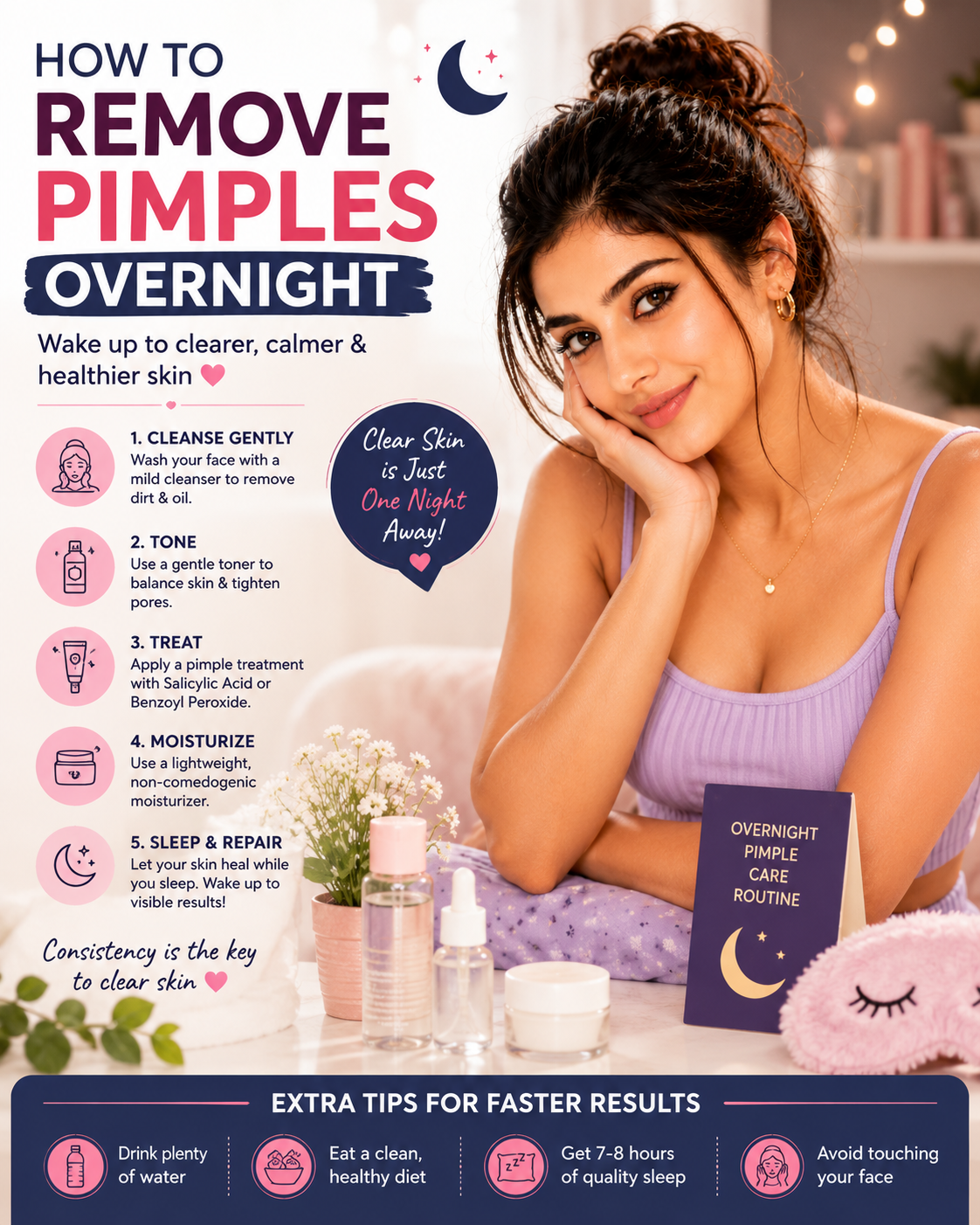
A pimple can appear at the worst possible time—just before a party, wedding, date, office meeting or an important event. And when you notice a red, swollen spot on your face at night, the first thought is usually: “How can I remove this pimple overnight?”
The truth is that most pimples cannot be completely eliminated in just one night. However, you can often make a pimple look less red, less swollen and less noticeable by following the right skincare steps and avoiding things that irritate the skin.
The key is not to attack the pimple with harsh home remedies. Instead, a simple routine involving gentle cleansing, an appropriate acne treatment, hydration and avoiding unnecessary touching can be much more helpful.
In this guide, we’ll explain how to care for a pimple overnight, which ingredients can help, whether ice or pimple patches are useful, what you should avoid and when it’s better to see a dermatologist.
Can You Actually Remove a Pimple Overnight?
Not usually.
A pimple develops because of a combination of factors such as clogged pores, excess oil, dead skin cells, bacteria and inflammation. Once a pimple has formed, it generally takes time for the inflammation and blockage to settle.
However, overnight care can sometimes improve its appearance.
Depending on the type of pimple, you may be able to:
- Reduce visible redness
- Reduce swelling
- Calm irritated skin
- Protect the area from touching
- Absorb fluid from some surface-level pimples
- Make the pimple less noticeable the next morning
So instead of promising a magical overnight cure, the realistic goal should be:
This approach is also less likely to leave your skin irritated or damaged.
How to Remove Pimples Overnight Safely
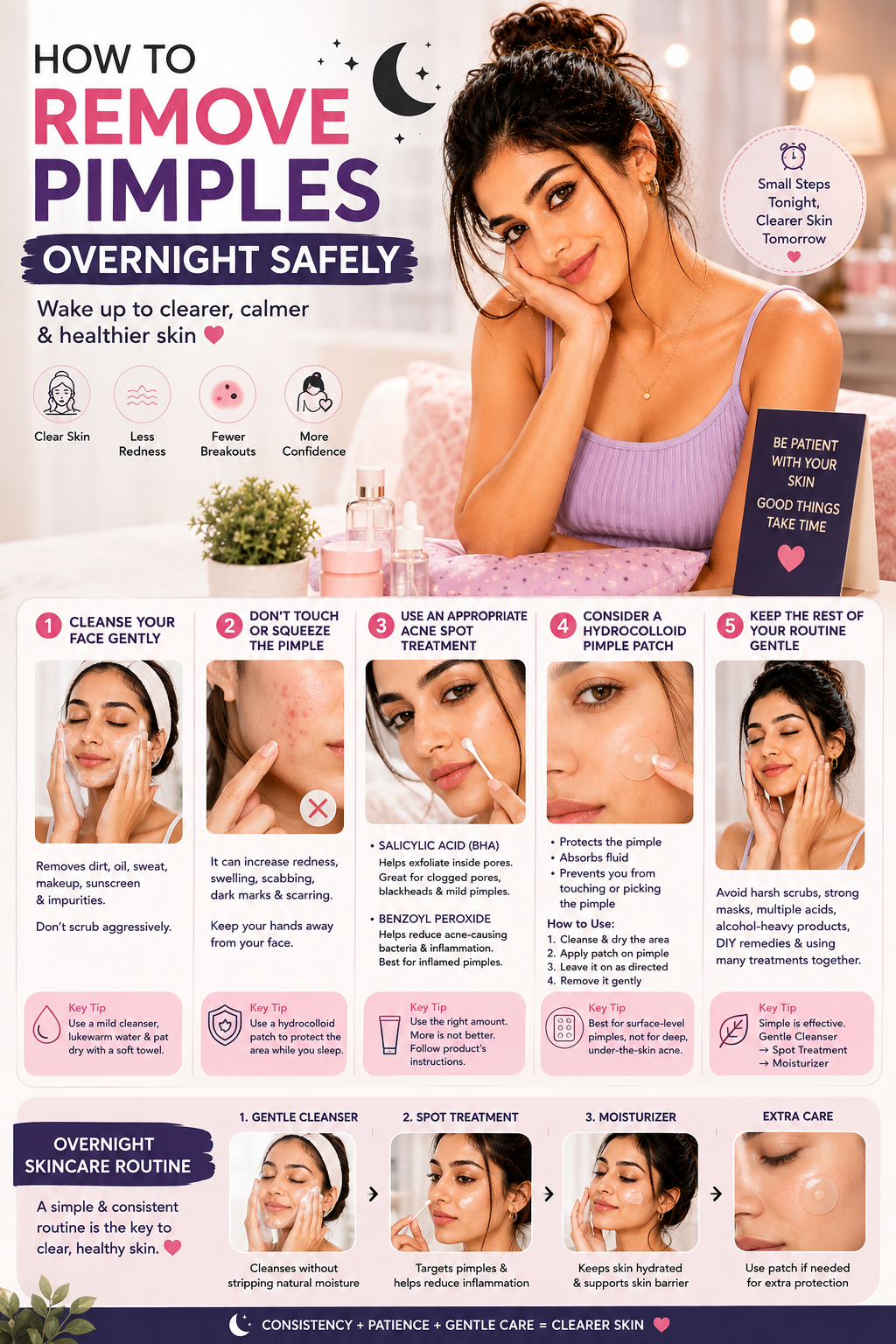
If you’ve suddenly developed a pimple and want to improve its appearance by morning, follow these basic steps.
Step 1: Cleanse Your Face Gently
Start by washing your face with a mild cleanser.
This helps remove:
- Excess oil
- Sweat
- Dirt
- Makeup
- Sunscreen residue
- Other surface impurities
Don’t scrub the pimple aggressively.
A harsh scrub can irritate the surrounding skin and potentially make redness more noticeable.
What to Do
Use lukewarm water and a gentle cleanser suitable for your skin type.
Massage the cleanser lightly with your fingertips and rinse thoroughly.
Then pat your face dry with a clean, soft towel.
Don’t rub the skin.
Step 2: Don’t Touch or Squeeze the Pimple
This is one of the most important overnight pimple-care rules.
When you see a large pimple, squeezing it can be tempting. But trying to force it out can increase irritation and inflammation.
Picking or squeezing can also potentially increase the risk of:
- Redness
- Swelling
- Scabbing
- Post-inflammatory dark marks
- Scarring
Instead:
Keep your hands away from the area.
If you find yourself touching your face while sleeping, a suitable hydrocolloid pimple patch may provide a physical barrier for certain surface-level pimples.
Step 3: Use an Appropriate Acne Spot Treatment
The right active ingredient depends on the type of acne and your skin’s tolerance.
Two commonly used acne ingredients are:
Salicylic Acid
Salicylic acid is a beta hydroxy acid (BHA) that can help exfoliate inside pores and is commonly used for acne and clogged pores.
It may be useful for:
- Clogged pores
- Blackheads
- Whiteheads
- Some mild pimples
- Oily or acne-prone skin
If you’re using a salicylic-acid product, follow the product’s directions rather than applying excessive amounts.
Benzoyl Peroxide
Benzoyl peroxide is another commonly used acne treatment.
It can help reduce acne-causing bacteria and inflammation and is widely used in acne treatment.
It may be particularly useful for inflamed pimples.
However, it can also cause dryness or irritation in some people.
Important:
Don’t assume that applying more product will make a pimple disappear faster.
Use the amount and frequency recommended on the product label or by a healthcare professional.
Step 4: Consider a Hydrocolloid Pimple Patch
If the pimple is suitable for a hydrocolloid patch, this can be one of the simplest overnight options.
Hydrocolloid patches work by creating a protective environment over certain superficial pimples and can absorb fluid from them.
They also have another useful benefit:
They Stop You From Touching the Pimple
Instead of repeatedly checking or squeezing the area, the patch creates a physical barrier.
This can be especially useful if you’re someone who tends to pick at pimples.
How to Use One
- Cleanse your skin.
- Dry the area completely.
- Apply the patch directly over the suitable pimple.
- Leave it on according to the product instructions.
- Remove it gently when recommended.
A hydrocolloid patch won’t magically remove every type of acne, especially deeper or under-the-skin pimples.
Step 5: Keep the Rest of Your Routine Gentle
One common mistake is changing your entire skincare routine because of one pimple.
You might be tempted to use:
- Scrubs
- Multiple acids
- Strong masks
- Alcohol-heavy products
- DIY remedies
- Several spot treatments together
This can actually make the situation worse.
Instead, keep the rest of your nighttime routine simple.
A Basic Routine
Gentle Cleanser → Appropriate Spot Treatment → Moisturizer
If you’re using a hydrocolloid patch, apply it according to its instructions and don’t layer unnecessary products underneath it.
Can Ice Reduce a Pimple Overnight?
Cold can temporarily reduce swelling and discomfort, which may make an inflamed pimple look less noticeable.
However, ice does not remove the underlying acne.
If you want to use cold:
- Wrap ice or a cold pack in a clean cloth.
- Never place ice directly against bare skin.
- Use it briefly rather than continuously.
- Stop if your skin becomes painful, numb or excessively irritated.
The purpose is to temporarily calm swelling—not freeze the pimple away.
What Type of Pimple Do You Have?
Before choosing an overnight treatment, it helps to understand what you’re dealing with.
🔴 Red Inflamed Pimple
These are raised, red bumps that may feel tender.
They can benefit from a gentle routine and appropriate acne treatment.
Avoid squeezing them.
⚪ Whitehead
A whitehead occurs when a clogged pore remains closed at the surface.
A suitable hydrocolloid patch may be useful for some surface-level whiteheads.
Avoid manually extracting it at home.
⚫ Blackhead
Blackheads are clogged pores that are open at the surface.
They usually don’t disappear overnight.
Ingredients such as salicylic acid can be useful as part of a consistent acne-care routine.
🔥 Deep Painful Pimple
A large, painful bump under the skin may be deeper inflammatory acne.
These pimples often cannot realistically be removed overnight.
Trying to squeeze them can make inflammation worse.
If deep or painful acne occurs repeatedly, professional evaluation can be much more useful than repeatedly trying DIY overnight treatments.
🚫 Don’t Put Toothpaste on Your Pimple
Toothpaste is one of the most commonly suggested DIY pimple remedies online.
But it’s not an appropriate acne treatment.
Toothpaste contains ingredients designed for teeth, not facial skin. Applying it to a pimple can cause:
- Irritation
- Dryness
- Burning
- Redness
- Skin barrier disruption
So if you’re wondering “Does toothpaste remove pimples overnight?”, the safer answer is:
No—don’t use toothpaste as a DIY acne treatment.
Use a product specifically formulated for acne instead.
🚫 Avoid Lemon Juice on Pimples
Lemon juice is another popular home remedy that should be avoided.
Its acidity can irritate the skin and may increase sensitivity.
Using lemon juice on an inflamed pimple can leave the surrounding area more irritated rather than clearer.
Natural doesn’t automatically mean skin-safe.
🚫 Don’t Scrub the Pimple
A pimple isn’t dirt that needs to be scrubbed away.
Aggressive exfoliation can increase irritation and make redness more obvious.
If you’re using an exfoliating acne ingredient such as salicylic acid, follow the product’s instructions rather than adding a harsh physical scrub on top.
🌙 Simple Overnight Pimple Routine
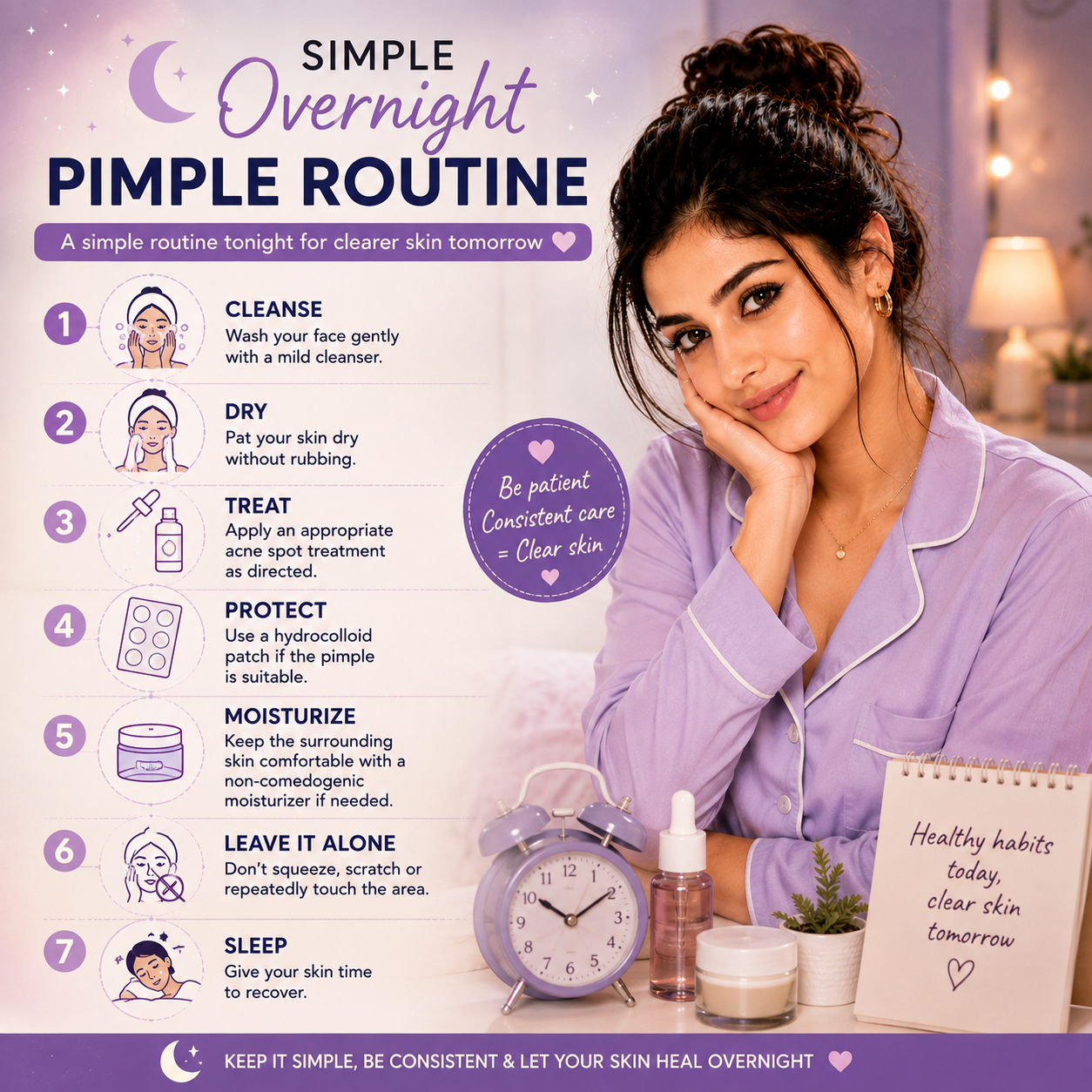
If you want a straightforward routine tonight, keep it simple:
1. Cleanse
Wash your face gently.
2. Dry
Pat your skin dry without rubbing.
3. Treat
Apply an appropriate acne spot treatment according to its instructions.
4. Protect
Use a hydrocolloid patch if the pimple is suitable.
5. Moisturize
Keep the surrounding skin comfortable with a suitable non-comedogenic moisturizer if needed.
6. Leave It Alone
Don’t squeeze, scratch or repeatedly touch the area.
7. Sleep
Give your skin time to recover.
🌅 What to Expect the Next Morning
You may notice that the pimple looks:
- Less swollen
- Less red
- Drier
- Flatter
- Less irritated
But results vary significantly depending on the type and severity of the pimple.
If the pimple is still visible in the morning, don’t panic and don’t immediately squeeze it.
Acne usually requires consistent care rather than a single overnight treatment.
🧴 Best Ingredients for Fast Pimple Treatment
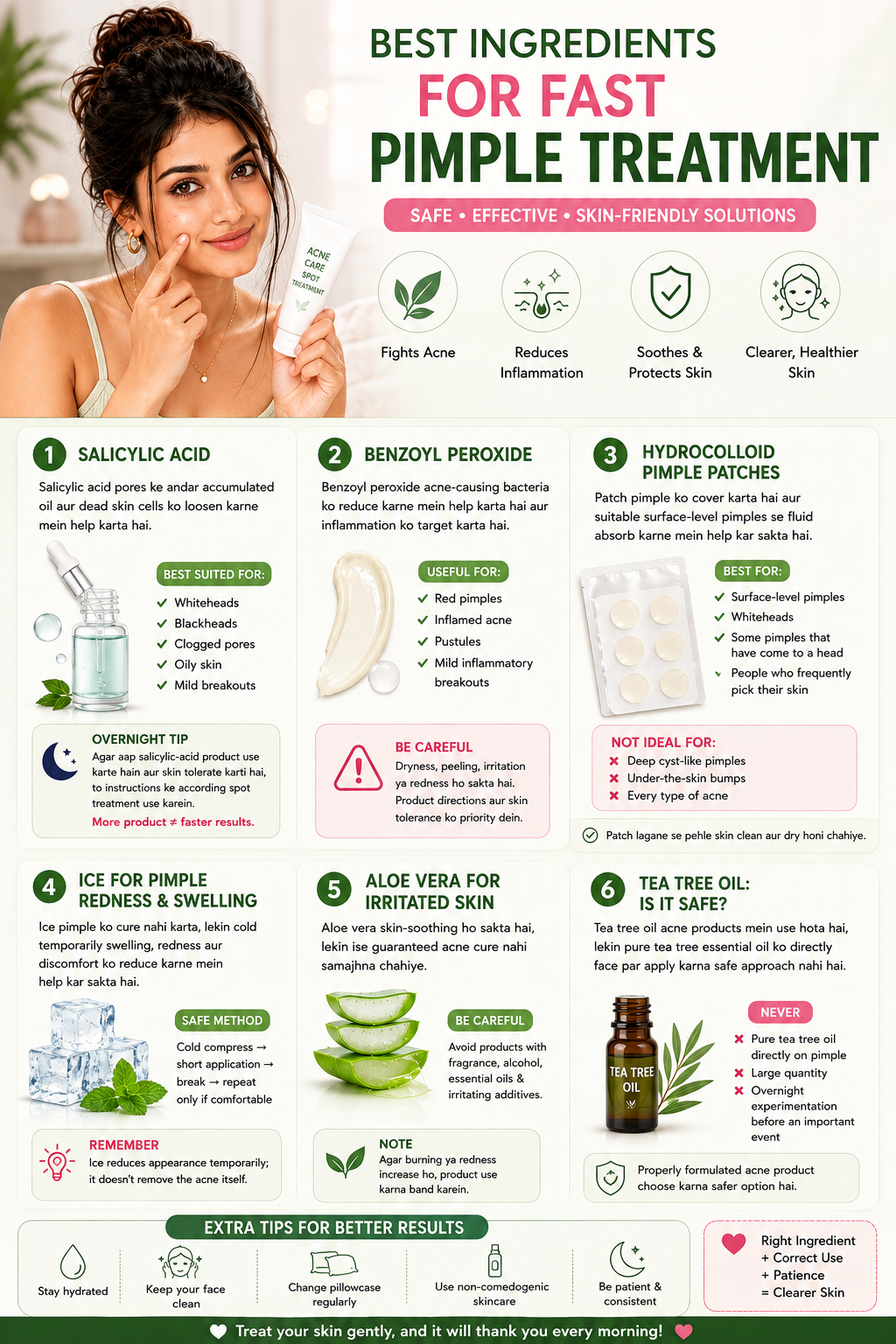
1. Salicylic Acid
Salicylic acid acne-prone skin mein commonly used ingredient hai. Ye pores ke andar accumulated oil aur dead skin cells ko loosen karne mein help karta hai.
Best suited for:
- Whiteheads
- Blackheads
- Clogged pores
- Oily skin
- Mild breakouts
Agar pimple ke aas-paas skin already irritated hai, to excessive salicylic acid use karna dryness aur irritation badha sakta hai.
Overnight Tip
Agar aap pehle se salicylic-acid acne product use karte hain aur skin usse tolerate karti hai, to product instructions ke according spot treatment use kiya ja sakta hai.
More product ≠ faster results.
2. Benzoyl Peroxide
Benzoyl peroxide inflammatory acne ke liye commonly used topical ingredient hai.
Ye acne-causing bacteria ko reduce karne mein help karta hai aur inflammation ko target karta hai.
Useful for:
- Red pimples
- Inflamed acne
- Pustules
- Mild inflammatory breakouts
Lekin benzoyl peroxide kuch users mein:
- Dryness
- Peeling
- Irritation
- Redness
cause kar sakta hai.
Isliye first-time use mein overnight miracle expect karne ke bajay skin tolerance aur product directions ko priority dein.
🩹 3. Hydrocolloid Pimple Patches
Hydrocolloid patches overnight pimple care ke liye popular hain, especially jab pimple surface par aa gaya ho.
Ye patch pimple ko cover karta hai aur suitable surface-level pimples se fluid absorb karne mein help kar sakta hai.
Iska biggest advantage?
Hands off!
Aap pimple ko baar-baar touch ya squeeze nahi karte.
Best for:
✔ Surface-level pimples
✔ Whiteheads
✔ Some pimples that have come to a head
✔ People who frequently pick their skin
Not ideal for:
❌ Deep cyst-like pimples
❌ Under-the-skin bumps
❌ Every type of acne
Patch lagane se pehle skin clean aur dry honi chahiye.
🧊 4. Ice for Pimple Redness and Swelling
Ice pimple ko cure nahi karta, lekin cold temporarily swelling, redness aur discomfort ko reduce karne mein help kar sakta hai.
Agar pimple kisi important event se pehle suddenly swollen ho gaya hai, cold compress short-term cosmetic improvement de sakta hai.
Safe Method
Cold compress → short application → break → repeat only if comfortable
Direct ice ko skin par mat rub karein.
Always use a clean cloth barrier.
Remember:
Ice reduces appearance temporarily; it doesn’t remove the acne itself.
🌿 5. Aloe Vera for Irritated Skin
Aloe vera ko skin-soothing ingredient ke roop mein use kiya jata hai, but it should not be treated as a guaranteed acne cure.
Agar pimple ke around skin irritated hai, a simple, fragrance-free aloe-based product some people may find soothing.
But be careful:
Har aloe product acne-prone skin ke liye suitable nahi hota.
Avoid products with unnecessary:
- Fragrance
- Alcohol
- Essential oils
- Irritating additives
Agar product use karne ke baad burning ya redness increase ho, use discontinue karein.
🌱 6. Tea Tree Oil: Is It Safe for Pimples?
Tea tree oil acne products mein use kiya jata hai, but pure tea tree essential oil ko directly face par apply karna safe approach nahi hai.
Undiluted essential oil irritation ya allergic reaction cause kar sakta hai.
Agar tea tree oil use karna hai, properly formulated acne product choose karna safer option hai.
Never:
❌ Pure tea tree oil directly on pimple
❌ Large quantity
❌ Overnight experimentation before an important event
🧴 Can Moisturizer Help a Pimple?
Yes, indirectly.
Many people stop moisturizing when they develop acne because they think moisturizer will make the skin oilier.
But over-drying the skin can make your routine more irritating.
A suitable non-comedogenic moisturizer can help maintain the skin barrier while you’re using acne treatments.
Look for:
✔ Lightweight texture
✔ Non-comedogenic formulation
✔ Suitable for your skin type
✔ Minimal unnecessary fragrance if your skin is sensitive
A healthy skin barrier makes an acne routine easier to tolerate.
🚫 Home Remedies That You Should Avoid
The internet is full of “overnight pimple hacks,” but many of them can irritate the skin.
❌ Toothpaste
Not designed for facial skin and can cause irritation.
❌ Lemon Juice
Can irritate skin and increase sensitivity.
❌ Baking Soda
Its high alkalinity can disrupt the skin barrier.
❌ Undiluted Essential Oils
Can cause irritation or allergic reactions.
❌ Alcohol
Strong alcohol-based DIY applications can excessively dry and irritate the skin.
❌ Garlic
Applying raw garlic to the face can cause significant irritation and even chemical burns.
❌ Harsh Scrubs
Scrubbing doesn’t remove the root cause of an inflamed pimple and can worsen irritation.
💡 What Actually Works Overnight?
If we rank the practical options for an average sudden pimple:
🥇 1. Don’t Touch It
This sounds simple, but it’s extremely important.
🥈 2. Use an Appropriate Acne Active
Choose according to the type of pimple and your skin’s tolerance.
🥉 3. Hydrocolloid Patch
Particularly useful for suitable surface-level pimples.
⭐ 4. Cold Compress
Can temporarily reduce swelling and redness.
⭐ 5. Gentle Moisturization
Helps prevent unnecessary barrier irritation.
The goal isn’t to throw five different products at one pimple.
Simple + consistent + gentle usually beats aggressive DIY treatment.
🌅 Tomorrow Morning
Don’t start experimenting with new aggressive products.
Instead:
Morning Routine
Gentle Cleanser → Moisturizer → Sunscreen
If the pimple is still red, you can use makeup designed for acne-prone skin if needed.
A non-comedogenic concealer can temporarily camouflage redness without requiring aggressive treatment.
💄 How to Hide a Pimple Without Making It Worse
Sometimes the fastest way to make a pimple less noticeable isn’t to remove it—it’s to temporarily cover it.
Step 1: Moisturize
Keep the surrounding skin comfortable.
Step 2: Use a Suitable Primer
If you normally use one, choose a non-comedogenic option.
Step 3: Apply Concealer
Use a small amount directly over the area.
Step 4: Don’t Layer Excessively
Too much makeup can make the raised texture more noticeable.
Step 5: Remove Makeup Properly
At the end of the day, cleanse gently rather than sleeping with makeup on.
🧠 Overnight Pimple Myths vs Facts
| Myth | Reality |
|---|---|
| Toothpaste removes pimples | ❌ Can irritate skin |
| Lemon juice clears acne | ❌ May cause irritation |
| Ice cures pimples | ❌ Can temporarily reduce swelling |
| Squeezing makes pimples disappear faster | ❌ Can worsen inflammation and marks |
| More acne treatment gives faster results | ❌ Can increase irritation |
| Pimples always disappear overnight | ❌ Most require more time |
| Pimple patches work for every acne type | ❌ Mostly useful for suitable surface-level pimples |
| Moisturizer causes acne | ❌ A suitable non-comedogenic moisturizer can be useful |
☀️ Morning After Overnight Pimple Treatment
Subah uthkar pimple ko immediately squeeze karne ki temptation avoid karein.
Morning Routine:
↓
↓
Sunscreen especially important hai agar pimple ke baad dark marks develop hone ki tendency hai.
🧴 How to Reduce Pimple Redness in the Morning
Agar subah pimple abhi bhi red hai, to:
Option 1: Cold Compress
Short, gentle cold application temporary redness and swelling ko calm kar sakti hai.
Option 2: Makeup
Agar aapko event attend karna hai, suitable non-comedogenic makeup se redness temporarily hide ki ja sakti hai.
Option 3: Leave It Alone
Sometimes the best treatment is simply not irritating it further.
👃 How to Deal With Pimples Around the Nose
The nose area can be oily because it contains many sebaceous glands.
If a pimple develops here:
- Don’t squeeze it
- Avoid aggressive scrubbing
- Use appropriate acne treatment
- Keep skincare gentle
Important
The skin around the nose can become irritated easily, especially if you’re already using exfoliating products.
😮 How to Treat Chin and Jawline Pimples
Chin and jawline breakouts can sometimes be associated with hormonal acne, especially when they repeatedly occur around the same area.
If you frequently develop painful pimples around the jawline or chin, treating individual pimples overnight may not solve the underlying issue.
A dermatologist can help determine the cause and recommend appropriate treatment.
🧴 Overnight Routine for Oily Skin
If your skin is oily and acne-prone, don’t make the mistake of trying to remove all oil.
Simple routine:
Gentle Cleanser
↓
Acne Treatment
↓
Lightweight Non-Comedogenic Moisturizer
↓
Optional Hydrocolloid Patch
The goal is to manage excess oil without unnecessarily damaging the skin barrier.
🌸 Overnight Routine for Sensitive Skin
Sensitive skin requires extra caution.
Instead of trying multiple active ingredients, keep your routine simple.
Suggested approach:
Gentle Cleanser → Simple Moisturizer → Suitable Patch if needed
If you already have a dermatologist-recommended acne product, follow those instructions.
Avoid experimenting with:
❌ Lemon
❌ Toothpaste
❌ Baking soda
❌ Raw essential oils
❌ Harsh scrubs
💧 What If Your Pimple Is Dry and Flaky?
If the pimple and surrounding skin are already dry, don’t keep applying more acne products.
Excessive treatment can increase irritation.
Instead:
- Reduce unnecessary actives
- Use a gentle moisturizer
- Avoid scrubbing
- Don’t peel the flaky skin
- Follow the directions of your acne treatment
🔥 What If the Pimple Is Painful?
A painful pimple may indicate deeper inflammation.
Don’t try to force it out.
Instead:
✔ Keep the area clean
✔ Avoid squeezing
✔ Consider an appropriate acne treatment
✔ Use a cold compress if comfortable
✔ Seek professional advice if painful breakouts are frequent
Deep, painful acne often needs more than an overnight home routine.
❌ What NOT to Do Before Sleeping
If you want your pimple to look better in the morning, avoid these mistakes.
Don’t:
❌ Pop the pimple
❌ Scratch it
❌ Apply toothpaste
❌ Apply lemon juice
❌ Use raw garlic
❌ Apply undiluted essential oils
❌ Use multiple strong acids together
❌ Scrub aggressively
❌ Sleep with makeup on
❌ Apply excessive amounts of spot treatment
💡 Can Drinking More Water Remove Pimples Overnight?
Staying hydrated is important for overall health, but drinking extra water before bed won’t magically remove a pimple overnight.
Don’t rely on viral “drink this much water and your pimple will disappear” claims.
Good acne care is based on consistent skincare, appropriate treatment and addressing the underlying causes.
🌙 The “Tonight to Morning” Quick Checklist
If you want a quick reference, save this:
Tonight
☐ Remove makeup
☐ Cleanse gently
☐ Dry your face
☐ Identify the pimple type
☐ Use appropriate acne treatment
☐ Apply hydrocolloid patch if suitable
☐ Moisturize
☐ Don’t touch or squeeze
☐ Get enough sleep
Morning
☐ Remove patch if applicable
☐ Cleanse gently
☐ Moisturize
☐ Apply sunscreen
☐ Avoid squeezing
☐ Use makeup if you need temporary coverage
🚨 When Should You See a Dermatologist?
Occasional pimples are common, but professional help may be appropriate if you have:
- Frequent painful acne
- Deep or cyst-like pimples
- Acne that leaves scars
- Persistent dark marks
- Widespread breakouts
- Acne that isn’t improving with appropriate OTC care
- Significant emotional distress because of acne
A dermatologist can determine whether you have comedonal, inflammatory or another type of acne and recommend treatment accordingly.
🌿 How to Prevent Pimples Naturally
You don’t need complicated skincare to reduce the chances of future breakouts.
Start with these simple habits:
1. Cleanse Regularly
Wash your face gently, especially after sweating.
Avoid repeatedly washing your face throughout the day because excessive cleansing can irritate the skin.
2. Don’t Pick Your Skin
Repeatedly touching or squeezing pimples can increase inflammation and may increase the chance of marks or scars.
3. Choose Non-Comedogenic Products
Look for skincare and makeup labeled non-comedogenic when possible.
This can be particularly useful if you have acne-prone skin.
4. Remove Makeup Before Bed
Don’t sleep with makeup on.
Use a gentle makeup-removal method followed by your normal cleanser.
5. Keep Hair Products Away From Your Face
Some hair oils, styling products and heavy conditioners can transfer onto the forehead or face.
If you frequently get forehead breakouts, consider whether your hair products are contributing to the problem.
☀️ Simple Morning Skincare Routine for Acne-Prone Skin
You don’t need ten products.
A basic morning routine can be:
Step 1 — Gentle Cleanser
Remove overnight oil and sweat without aggressively stripping the skin.
Step 2 — Suitable Acne Treatment
If you use an acne treatment recommended for your skin, apply it according to its instructions.
Step 3 — Moisturizer
Use a lightweight, non-comedogenic moisturizer if your skin needs hydration.
Step 4 — Sunscreen
Finish with a broad-spectrum sunscreen.
Sunscreen is especially useful when you’re concerned about the appearance of dark marks left after pimples.
🌙 Simple Night Skincare Routine
Your nighttime routine can be even simpler:
Cleanser → Acne Treatment → Moisturizer
If you’re using a hydrocolloid patch for a suitable surface-level pimple, follow the patch’s instructions.
The goal is consistency rather than adding multiple active ingredients every night.
🧴 How to Choose Products for Acne-Prone Skin
When shopping for acne skincare, don’t simply choose the product with the longest ingredient list.
Look for:
✔ Appropriate Acne Actives
Depending on your acne type, ingredients such as salicylic acid or benzoyl peroxide may be useful.
✔ Non-Comedogenic Formulas
This can be helpful for people prone to clogged pores.
✔ Gentle Cleansers
Avoid products that leave your skin extremely tight or irritated.
✔ Lightweight Moisturizers
Acne-prone skin still needs hydration.
✔ Sunscreen
Especially important if you’re prone to post-acne dark marks.
🩹 How to Prevent Pimple Marks
Sometimes the pimple disappears but leaves a dark or red mark behind.
This can be frustrating.
The best strategy is to reduce unnecessary inflammation and avoid picking or squeezing pimples.
Sunscreen also matters
Sun exposure can make some post-inflammatory pigmentation appear more noticeable or last longer.
Therefore, daytime sunscreen should remain part of your skincare routine.
💡 What Is the Fastest Way to Make a Pimple Less Noticeable?
If you need the simplest answer:
At Night
Cleanse → Appropriate spot treatment → Hydrocolloid patch if suitable → Moisturizer
In the Morning
Gentle cleanse → Moisturizer → Sunscreen
If swelling remains, a brief cold compress may temporarily reduce its appearance.
If you need immediate cosmetic improvement, non-comedogenic makeup can provide temporary coverage.
👩🦰 Best Pimple Routine for Teenagers
Teenage skin can be oily and acne-prone, but that doesn’t mean it needs an aggressive routine.
A simple approach is usually better:
Morning
Gentle Cleanser → Moisturizer → Sunscreen
Night
Gentle Cleanser → Appropriate Acne Treatment → Moisturizer
Avoid copying complicated routines from social media.
If acne is severe, painful or leaving scars, professional advice is more appropriate than repeatedly trying DIY remedies.
💻 Acne Care for People Who Spend Long Hours on Screens
Screens themselves don’t directly cause acne.
However, long working or study sessions can sometimes be associated with habits that may affect skin:
- Touching the face frequently
- Not washing after sweating
- Poor sleep schedule
- Stress
- Makeup remaining on the skin for too long
Instead of blaming your phone or laptop, focus on the actual habits surrounding them.
🏃 Pimples After Exercise or Sweating
Sweating itself doesn’t automatically cause acne, but sweat, oil, friction and occlusive clothing or equipment can contribute to breakouts in some people.
After exercising:
Try to:
✔ Shower or cleanse when practical
✔ Change out of sweaty clothing
✔ Avoid repeatedly wiping your face with dirty hands
✔ Clean equipment that touches your skin
✔ Avoid heavy makeup during workouts
📅 How Long Does It Usually Take for a Pimple to Go Away?
There is no single timeline.
A small superficial pimple may improve relatively quickly, while deeper inflammatory acne can take much longer.
This is why an overnight routine should focus on reducing appearance and irritation, not guaranteeing complete removal.
🧠 Why Do Pimples Keep Coming Back?
Recurring acne can have several contributors, including:
- Excess sebum
- Clogged pores
- Hormonal changes
- Inflammation
- Genetics
- Certain medications
- Skin or hair products
- Stress
- Other underlying factors
If breakouts repeatedly occur in the same areas or are becoming painful, a dermatologist can help identify the underlying pattern.
🚨 When an Overnight Solution Isn’t Enough
Don’t keep experimenting with home remedies if:
- Acne is severe
- Pimples are deep and painful
- You have frequent cyst-like breakouts
- You’re developing scars
- Dark marks are increasing
- Acne is affecting your confidence significantly
- OTC products aren’t helping
In these situations, professional acne treatment may provide a much better long-term solution.
🌟 The Best Acne Strategy Is Consistency
There’s no need to completely redesign your skincare routine every time you see a new pimple.
Instead:
Gentle Cleansing
↓
Appropriate Acne Treatment
↓
Moisturization
↓
Sun Protection
↓
No Picking
↓
Consistency
This approach is far more realistic than searching for a miracle overnight remedy every few days.
📚Related Articles You May Like
Continue your skincare journey with these GlowifyHub guides:
- Best Sunscreen for Acne-Prone Skin
- Best Moisturizer for Oily Skin in India
- How to Get Soft Hair Naturally
- Best Hair Mask for Damaged Hair
- Dot & Key Vitamin C Face Wash Review
- Minimalist 7% ALA + AHA Face Wash Review
- Lakme Unreal Glow Primer Review
- Swiss Beauty Mattifying Makeup Primer Review
- MARS Glow O’ Clock Primer Review
- Top 10 Beauty Products for College Girls
🌸 Final Verdict
If you’re searching for how to remove pimples overnight, it’s important to set realistic expectations.
A pimple generally can’t be guaranteed to disappear completely in one night. But you can often make it less red, less swollen and less noticeable by morning with a simple, gentle routine.
The most useful strategy is:
Gentle Cleansing → Appropriate Acne Treatment → Hydrocolloid Patch When Suitable → Moisturizer → No Picking
And if swelling is your main concern, a brief cold compress may provide temporary relief.
Avoid viral DIY remedies such as toothpaste, lemon juice, raw garlic and baking soda. They can irritate the skin and potentially leave you dealing with a bigger problem than the original pimple.
For long-term results, focus on a consistent skincare routine rather than searching for an overnight miracle every time a pimple appears.
And if your acne is frequent, painful, deep, scarring or persistent, it’s better to consult a dermatologist.
❓ Frequently Asked Questions
1. How can I remove a pimple overnight?
You usually cannot completely remove a pimple overnight, but you may be able to reduce its appearance. Gently cleanse your skin, avoid squeezing, use an appropriate acne treatment and consider a hydrocolloid patch for a suitable surface-level pimple.
2. How can I reduce pimple redness overnight?
A gentle skincare routine, appropriate acne treatment and a brief cold compress may help reduce the appearance of redness and swelling. Avoid squeezing or scrubbing the pimple.
3. Can a pimple disappear in one night?
Sometimes a very small pimple may look significantly better by morning, but most pimples do not completely disappear overnight. The result depends on the type and severity of the acne.
4. What should I put on a pimple overnight?
Depending on the type of pimple, an appropriate acne spot treatment or hydrocolloid patch may be useful. Always follow the product’s directions and avoid applying multiple strong ingredients at once.
5. Is salicylic acid good for pimples?
Salicylic acid is a commonly used acne ingredient that can help unclog pores and is particularly useful for certain types of acne, including blackheads and whiteheads.
6. Is benzoyl peroxide good for pimples?
Benzoyl peroxide is a commonly used topical acne treatment that can help reduce acne-causing bacteria and inflammation. It can cause dryness or irritation in some people.
7. Can ice reduce a pimple?
A cold compress may temporarily reduce swelling, redness and discomfort, but it does not remove the underlying acne.
8. Should I pop a pimple before bed?
It’s generally better not to pop a pimple yourself. Squeezing can increase inflammation and may increase the chance of post-acne marks or scarring.
9. Do pimple patches work overnight?
Hydrocolloid patches can be useful for some surface-level pimples, particularly those that have come to the surface. They don’t work equally well for every type of acne.
10. Does toothpaste remove pimples?
No. Toothpaste isn’t an acne treatment and can irritate or dry out facial skin.
11. Does aloe vera remove pimples overnight?
Aloe-based products may feel soothing for some irritated skin, but aloe vera should not be considered a guaranteed overnight acne cure.
12. Can I use lemon on a pimple?
It’s better to avoid applying lemon juice directly to facial skin because it can cause irritation and sensitivity.
13. How do I shrink a big pimple overnight?
You may be able to temporarily reduce swelling with a brief cold compress and use an appropriate acne treatment. Deep, painful pimples usually cannot be completely flattened overnight.
14. What is the fastest way to treat a pimple?
The fastest safe approach depends on the type of pimple. Appropriate spot treatment, hydrocolloid patches for suitable surface-level pimples and avoiding picking can help improve its appearance.
15. Why do I keep getting pimples?
Recurring acne can have several contributors, including excess oil, clogged pores, inflammation, hormonal changes, genetics and certain products or medications. Persistent acne may require professional evaluation.